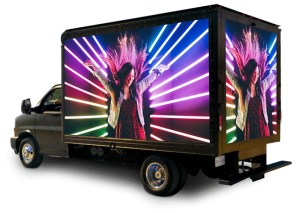

Choosing the right billboard ad size is one of the most strategic decisions you’ll make for any outdoor campaign. The size you pick affects visibility, readability, creative possibilities, cost, and—most importantly—how quickly a passerby understands and acts on your message.
Table of Contents
ToggleWhat is the Standard Billboard Size in Canada?
When navigating the Canadian Out-of-Home (OOH) advertising landscape, understanding dimensions is the first step toward a high-impact campaign. While Canada shares some similarities with the American market, the Canadian industry has its own unique «Golden Standards» designed to capture attention in major hubs like Toronto, Montreal, Edmonton and Vancouver.
In Canada, billboard sizes are categorized into three primary dimensions that offer maximum reach and visibility:
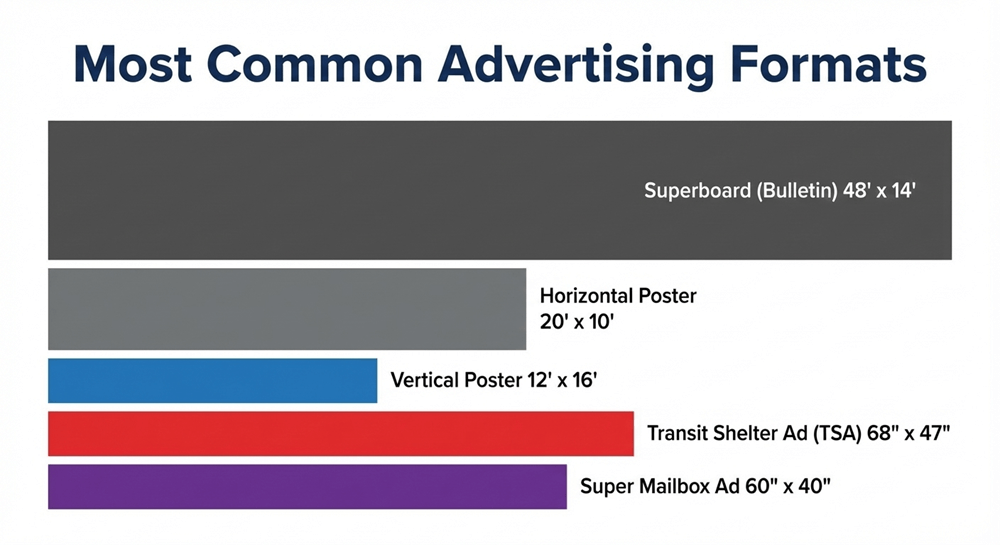
Superboards (Bulletins): 14 feet high by 48 feet wide
The «King of the Highway.» These are the massive displays found along major arteries like the 401 or the QEW. They offer the largest canvas for brands looking to establish dominance and prestige.
Posters (Horizontal): 10 feet high by 20 feet wide
This is the most ubiquitous billboard size in Canada. Positioned primarily on surface streets and in urban high-traffic areas, the 10’x20′ format is the workhorse of Canadian advertising, providing high frequency and localized impact.
Transit Shelter Ads (TSA): 5.7 feet high by 3.9 feet wide (approx. 68" x 47")
In Canada’s densest cities, street-level visibility is key. While technically «street furniture,» these are often referred to as «mini-billboards.» They are strategically placed at eye level to capture both pedestrian traffic and commuters in transit.
Billboard Ad Sizes — Standard Outdoor Advertising Formats
| Format (Type) | Typical Dimensions (feet) | Common Use |
|---|---|---|
| Bulletin | 14′ × 48′ (4.27m × 14.63m) | Highways, major roads, long-distance visibility |
| Spectacular | 20′ × 60′ and larger | Major cities, premium high-impact branding |
| Poster / 30-Sheet | ~10′ × 22′ (3.05m × 6.71m) | Urban streets, secondary highways, retail areas |
| Junior Poster / 8-Sheet | ~6′ × 12′ (1.83m × 3.66m) | Neighborhoods, downtown areas, close-range viewing |
| Mobile Billboard Panel | ~6.5′ × 11′ (~2m × ~3.35m) | Truck sides, mobile routes, events |
| Digital Bulletin | ~14′ × 48′ LED display | High-traffic highways with rotating digital ads |
| Digital Poster | ~10′ × 22′ LED screen | Urban digital networks with scheduled rotations |
| Tri-Vision / Rotating Billboard | Varies (based on standard formats) | Locations requiring multiple rotating messages |
Popular Billboard Banner Ad Sizes Explained (And Why They Work)
The size of billboard banner ads is one of the most decisive factors in visual impact, brand recall, and return on investment. Choosing the right size doesn’t just improve visibility — it determines how long people can read and mentally process your message.
🟦 Bulletin (14′ × 48′)

The most iconic and powerful billboard ad size.
Designed for highways and high-speed roads
Visible from long distances
Ideal for branding, launches, and established brands
🟦 Poster / 30-Sheet (10′ × 22′)

One of the most balanced billboard formats.
Perfect for urban and commercial areas
Lower cost than a bulletin
Strong balance between reach and frequency
👉 It works because it connects well with slow-moving traffic and pedestrians.
🟦 Junior Poster / 8-Sheet (6′ × 12′)

A compact and highly strategic format.
Neighborhoods, downtown areas, residential zones
Ideal for local promotions
High close-range visibility
👉 It works because the message is read clearly at short distances without distraction.
🟦 Spectacular (20′ × 60′ or larger)

The most visually impactful format.
Premium locations
Strong emotional and visual power
Used by brands seeking massive visibility
👉 It works because it turns advertising into a city landmark.
🟦 Digital Billboard Ads (LED Formats)
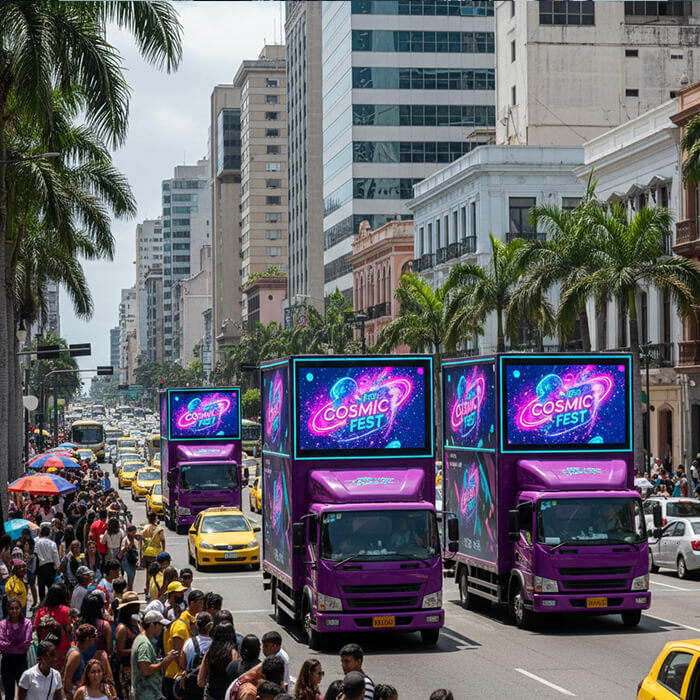
Digital billboard ads use high-resolution LED screens to display dynamic content in the same prime locations as traditional billboards
Common digital billboard ad sizes include 14′ × 48′, 10′ × 20′, and large custom LED walls
Supports motion, transitions, and multiple creatives
Allows ads to rotate by time of day, traffic flow, or audience behavior
👉 This format works because a single billboard ad size can deliver multiple messages, increase frequency, and adapt in real time — maximizing visibility, recall, and overall campaign performance.
🟦 Digital Billboard (LED formats)

A modern evolution of traditional sizes.
Rotating ads
Dynamic messaging
Time-based optimization
👉 It works because a single billboard ad size can deliver multiple impressions.
🎯 Strategic takeaway
There is no single “perfect” size. The best billboard ad size depends on:
Traffic speed
Viewing distance
Campaign objective (branding vs conversion)
Budget
Choosing the right billboard banner size is the difference between being seen and being remembered.
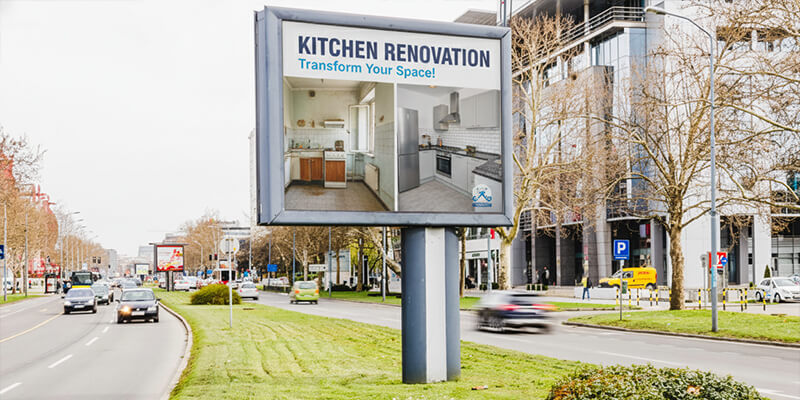
How to Choose the Best Billboard Ad Size Based on Your Campaign Goals
Not all campaigns need the largest Billboard Ad Size. Sometimes, a medium or small Billboard Ad Size delivers stronger engagement.
Here’s how to match your goals with the perfect Billboard Ad Size:
Goal: Brand Awareness
You need broad visibility → choose the largest available Billboard Ad Size.
This ensures instant recognition, even from a distance.
Goal: Promote an Offer or Event
A medium Billboard Ad Size offers enough space for clear messaging while staying close to high-density audiences.
Goal: Target Local Neighborhoods
Goal: Drive Conversions
billboard banner ad size — Why Bigger Isn’t Always Better
A common misconception is that the largest Billboard Ad Size always wins.

But that’s not true. Sometimes the most effective Billboard Ad Size is the one that matches:
- The traffic speed
- The audience type
- The surrounding environment
- The distance between viewer and board
- The campaign’s messaging style
For example, promoting an urgent call-to-action near a point-of-sale location works best with a medium Billboard Ad Size, not a massive highway board.

How Billboard Ad Size Influences Design Strategy
Your creative team must adapt design depending on the Billboard Ad Size.
Here’s how size affects visuals:
Small Billboard Ad Size
- Concise messaging
- Simple layouts
- Bold fonts
- Close-range readability
Medium Billboard Ad Size
- Balanced graphics
- Short headline
- Clear branding
- Key detail allowed
Large Billboard Ad Size
- Balanced graphics
- Short headline
- Clear branding
- Key detail allowed
A great creative concept fails instantly if mismatched with the wrong Billboard Ad Size.
billboard banner ad size — Mistakes to Avoid When Choosing Your Billboard Ad Size
| Common Mistake | Why It Hurts Ad Performance |
|---|---|
| Choosing a billboard ad size that’s too small | Reduces visibility from a distance and makes the ad easy to ignore |
| Ignoring traffic speed | Faster-moving traffic requires larger, simpler billboard ad sizes |
| Using too much text for the format | The message can’t be processed quickly, reducing impact |
| Overlooking billboard placement | An incorrect billboard ad size fails to maximize angles, height, and visibility |
| Not adapting the design to the format | Forcing a generic layout lowers clarity and recall |
| Focusing on cost instead of visibility | Saving on billboard ad size often leads to fewer impressions and weaker ROI |
billboard banner ad size — Cost Considerations Based on Billboard Ad Size
Naturally, Billboard Ad Size affects cost — but not always the way you think.
1. Larger Billboard Ad Sizes cost more upfront, but because they reach massive audiences, they often deliver the lowest cost per impression.
2. Smaller Billboard Ad Sizes cost less and can be hyper-targeted, giving you incredible value in dense urban areas.
3. Medium Billboard Ad Sizes offer the best of both worlds: strong reach at a competitive cost.
Turn visibility into real results
Talk to a specialist and define the billboard ad that best suits your objective, location, and budget.
¿De cuánta utilidad te ha parecido este contenido?
¡Haz clic en una estrella para puntuarlo!
Promedio de puntuación 5 / 5. Recuento de votos: 1
Hasta ahora, ¡no hay votos!. Sé el primero en puntuar este contenido.